Corporate Events


- Drinks and Hors D'Oeuvres
- Receiving Lines
- Greeting the Host
- Dinner Service
- Hosting a Catered Function
Drinks and Hors D'Oeuvres
At a business event with a formal dinner as its centerpiece, pre-dinner drinks and hors d'oeuvres will probably be served. Our recruiting event section discusses these dining etiquette topics in detail, the concepts are the same here.
Receiving Lines
If your function has more than sixty (60) people, a receiving line will speed introductions.
Guests may hold a drink while standing in the line, but should set their glasses down before they go through. There are usually servers with trays standing by to take glasses - if not, find a table to leave your glass.
When greeting people in the line, shake hands and briefly exchange words with each person. Avoid lengthy conversations.
If the party has no receiving line, the host may appoint two or three people as introducers. Introducers make sure that every person who arrives eventually meets the host at some point during the evening. Make it a point to locate the host on your own if necessary, so that you're able to briefly thank him or her for the hospitality.
Greeting the Host
Find the host and thank him or her for the evening. If you are unable to thank the host personally, send a note the following day, thanking them and giving your regrets that you weren't able to thank him or her in person.
Table Manners
At a large sit-down dinner, you'll often be seated with strangers. People seated together at a table always introduce themselves to each other as a sign of courtesy and respect, even when they expect to conduct separate conversations.
Dinner Service
At formal dinners, an empty service plate (called a "charger" or "place plate") will be set at each diner's place. A napkin may be placed in the plate's center. Or, a cold first course may already be set on the service plate, with the napkin to the left of the forks. The only time a plate will not be set before guests is just before dessert, when a waiter clears all the dishes from the table and crumbs from the tablecloth.
The waiter will serve the food from your left side and remove dishes from your right side. After the soup course, the waiter will remove the soup bowl and its underplate and replace them with a warm dinner plate or a plate already holding the main course. If a first course is followed by soup, the service plate remains until the soup course is finished.
See our "Table Manners" and "Table Setting" sections for more detailed discussions of dining etiquette at a formal dinner.
Hosting a Catered Function
Follow these guidelines if you are representing your company at an official function:
- Enjoy the food and drink, but your interest in them should be downplayed. The host should never go through the buffet line with the guests. After all the guests are served, the host (and salesmen) may fill a plate with a few items and circulate among the guests.
- Always eat and drink lightly.
- Assume that business will be discussed unless the event is very informal.
- Finally, plan to leave before the party ends, and definitely before the time stated on the invitation.
Table Manners
It's easy to impress at the dinner table! Just take a few minutes to read through our table manners section and you'll be the most sophisticated diner at the table.
Read MoreInternational Dining Etiquette
Visit our international dining etiquette section for more etiquette tips for your next trip overseas or hosting international guests!
Read More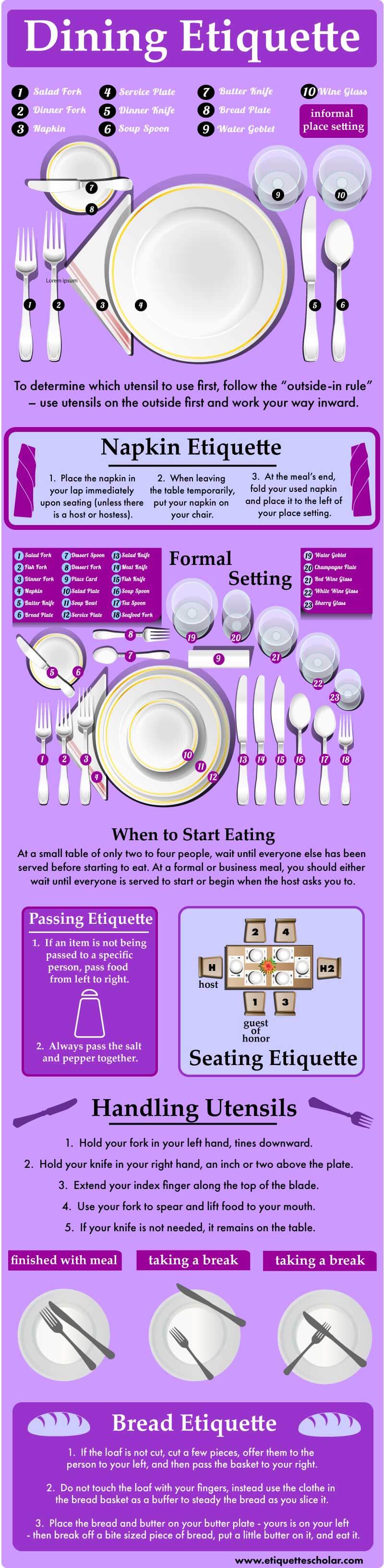
Dining Etiquette
See more dining etiquette lists...